Aquarium and pond UV Sterilizer

Your Ad Here
aquarium and pond UV posts, information, articles, resources, blogs

AQUARIUM AND POND UV STERILIZER ARTICLES;
Information articles (posts), ideas, comments, and links to even more information about how UV (UVC) Sterilization works in aquariums and ponds.
For a COMPLETE up to date article about aquarium and pond uv sterilization, please visit this site:
UV Sterilization in Aquariums and Ponds; How it works
For all Posts/Articles from this site (most are basic, however a few are advanced as well), please scroll down the right side of this site for easy links

For more Aquarium and Pond information, articles, help, & resources please visit this site:
Aquarium and Pond Information, help, advice, basics, articles

Friday, May 08, 2009

UVC irradiation and immune response

UVC irradiation and immune response
This includes human research into BioPhotonic Therapy and UVBI Therapy


This article/post is meant to expand on my previous article “Fish Immune System and UV Sterilization”), this time utilizing information about UVC irradiation as per human studies and its affect on disease treatment and over all health.
While the application to fish in aquariums/ponds is somewhat “apples to oranges” in comparison at this point in time, the implications are certainly far reaching as to the affect on Aquatic Redox and fish health.

Since most in depth research is found in human studies to do to the costs involved vs. the unfortunately common anecdotal comments made about UV Sterilization in the aquarium hobby that are years behind real research, this is where one needs to go to find good and cutting edge research. In fact I just recently came across this gem of a post of anecdotal bad information from an otherwise good aquatic article: “For me, a UV filter is just a ‘feel good’ device and leads hobbyists into a false sense of security” It is too bad that so many aquarium keepers simply refuse to do their homework, but this is likely to continue considering how lazy many persons can be at times (otherwise how can you explain the popularity of such terrible sites for aquatic information such as Yahoo Answers among many others, or directories such as DMOZ with its outdated directories).

The concept of BioPhotonic Therapy and UVBI Therapy was brought to my attention in an email and phone call by a researcher (Dr. Mamoon Kundi) who found me via my UV and Redox research articles.
One concept is clear and that is that the use of UVC lamps can affect both the oxidizing and reducing side of the Redox Balance equation that is so important for life.

Studies in UV Irradiation

 BioPhotonic, UVBI Therapy  DeviceIn these studies, blood is irradiated (via different methods), often with very pronounced results. William Campbell Douglass, MD, who treats his patients using only alternatives and has written several books on these subjects, wrote a book called Into the Light, where he recommends Photoluminescence Therapy for the following conditions:
• Immune deficiency problems
• Viral Infections (hepatitis, respiratory, etc.)
• Pneumonia
• Non-healing wounds and wound infections
• Emphysema
• Inflammatory Processes: fibrositis (inflammation of, mainly, the muscle sheath), bursitis, iritis (inflammation of the iris), pancreatitis, etc
• Autoimmune diseases: rheumatoid arthritis, AIDS, etc.
• Osteomyelitis (bacterial infection of the bone marrow)
• Septicemia (virulent infection of the blood)
• Cancer (experimental at present)
• Peripheral vascular disease
• Most vascular disease
• Thrombophlebitis (inflammation of a blood vessel that results in blood clots)


Implications of this research as per aquariums/ponds
While we as aquarium and pond keepers are not too likely to utilize these UV blood irradiation therapies on our fish, this still has implications as to how a UV Sterilizer can be an important part of ANY aquarium keeper’s (or pond keeper) filtration system in that this latest research backs up many of my own tests and research going back to the early 1990s. The implications of the affect of the UV irradiation on how it may not necessarily outright kill pathogenic microbes found in the water column, however it certainly allows for an improved fish immune system response to pathogens, which is one of my earlier findings as well (although I did not know the whys of my test results back then). The affect of UVC irradiation also has a positive affect on Aquarium Redox Balance which is also important for aquatic health.

The bottom line is this is just one more piece of evidence that a correctly installed UV Sterilizer should be part of every serious aquarist filtration system, especially those who keep expensive, rare, or delicate fish.

Please read or at least glance over these referenced articles (more to come too):

*http://www.bio-photonictherapy.info/Home_Page.html
*http://www.oxygenhealingtherapies.com/uvb_therapy.html
*http://www.healing.org/only-7.html

As well as my UV Sterilization Article

Monday, March 09, 2009

UVC, Watts, Microwatts

UVC, Watts, Microwatts, Joules, & light penetration

This article/post is intended to give some basic understanding between the relationship of watts, microwatts, joules of UVC energy and how this translates to UV Sterilizer effectiveness.

Please keep in mind that the diagram in this article is based on air penetration, so some extrapolation is necessary for use in water applications (which is the primary intention of this article, although the principles apply to UVC air sterilization devices as well)

What is a Watt/Microwatt?

One Joule of energy = 1,000 milliWatt seconds = 1,000,000 microWatt seconds
One joule is the amount of energy required to perform the following actions:

• The work done by a force of one newton traveling through a distance of one meter (a newton is the unit of force equal to the amount of force required to accelerate a mass of one kilogram at a rate of one meter per second per second);
• The work required to move an electric charge of one coulomb (the amount of electric charge transported by a current of 1 ampere in 1 second) through an electrical potential difference of one volt; or one coulomb volt, with the symbol C•V;
• The work done to produce power of one watt continuously for one second; or one watt second (compare kilowatt hour), with the symbol W•s. Thus a kilowatt hour is 3,600,000 joules or 3.6 megajoules;
• The kinetic energy of a 2 kg mass moving at a velocity of 1 m/s. The energy is linear in the mass but quadratic in the velocity, being given by E = ½mv²;
we measure UV-C intensity in Micro-Watts that strike one square centimeter of surface area.

UVC Penetration:
(From UV Sterilization; how it works for aquariums, ponds, & more)


The emission or light intensity of a UVC germicidal light bulb is usually expressed in a term called "microwatts per square centimeter" (Mw/cm2). The maximum intensity provided by a single UVC Bulb is at its surface. So, if we calculate the surface area of the UVC lamp and only use that area which effectively emits UVC light rays, the effective area of UVC transmission will be established. Basic mathematics will show that the surface area of a cylindrical tube is ‘pie’ D L.

Next extrapolate this effective area of UVC transmission as having a screen with squares 1 centimeter in size. Each of these cm2 areas now, for measurement purposes, emits a UVC lamp intensity measured in microwatts, in other words; the term microwatts/cm2. UVC light intensity decreasingly varies as the distance from the UVC light increases.

Put more simply (a non scientific analogy); The amount of wattage will also increase penetration, as a higher watt UVC bulb will generally have more Mw/cm2. In my own experiments I have used 15 watt and 25 watt UVC bulbs in exactly the same unit (both were 18”), if wattage were only considered there would be a 60% increase in effectiveness, however I only observed a about a 25% increase. When I used a 30 Watt UVC bulb in a unit with over twice the exposure as the 15 Watt, the kill rate more than doubled. From my experience, if you increase wattage (and Mw/cm2) you need to also increase the volume of water to maximize the higher watt bulb.
Experiments can also be safely conducted with standard household light bulbs to correlate penetration. For this start with a 7 watt clear bulb (such as a Christmas bulb) and place varying thicknesses of paper/ cardboard in front of the bulb and measure when penetration stops. Continue this with higher and higher wattage bulbs.

UVC Intensity The Diagram to the left can give a rough comparison of distance as per UVC energy as expressed by MW/cm2 in Air transmission.
The dose applied by an UV-C lamp installation is a function of the lamp output, the intensity factor, and time. As an equation; Intensity x Exposure time= microwatt seconds/cm2.
As an example, a 9 watt UVC lamp at one inch from the lamp is found by this formula:
9 x 127 = 1143 mW/cm2.
Since many bacteria such as Vibrio require a UVC exposure of 6500 mW/cm2 or more, this means an exposure time of 5.68 seconds is required to kill this pathogen


Now let me point out that even though I have published this diagram, please use this as a rough guide only, as I have found inaccuracies in it. To be more blunt; I have found the distance, wattage, and flow rate to be the MOST IMPORTANT factors in determining exposure/effectiveness. This diagram is STATIC and does NOT take into consideration the dynamics of UVC radiation penetration for which I have yet to find a good formula to demonstrate this (even in University studies).
What is often missing in any equations I have seen is the dynamics of water flow geometry, actual water flow, and wattage. The bottom line is to use this table and others you might find elsewhere with “a grain of salt” noting that these are static and even then are flawed when true output via wattage is taken into consideration.

Further Reading, references:

* UV Sterilization; how it works for aquariums, ponds, & more


*http://www.hygienitech.com/Hygienitech%20UV-C%20Light%20Primer.pdf

*http://www.solartanic.com/index_022.htm

Saturday, November 29, 2008

Aquarium UV Sterilizer Ideas

Aquarium UV Sterilizer Ideas; Part Two

In part one about 18 months ago I noted using intake and return adapters as another way to connect UV Sterilizers to aquariums, especially smaller aquariums where the use of more traditional set ups such as canister filter or sumps is not possible.
In this article I will expand on this idea and as well note some problems with many sump set ups and with the growing popularity of internal UV Sterilizers, which although they make work, they are prone to leak problems that usually result in a short lifespan.

First I will start with the use of power heads, pumps, or Internal Filters (which is my first choice do to pre filtration of water allowing for a more effective UV Sterilizer).
Aquarium UV installation diagram with Internal Filter or Power head
Here is a basic picture for plumbing a compact UV Sterilizer using an Internal Filter or Power Head. The lines and can be much more neatly placed than the diagram (this is just for emphasis). This demonstration is shown on the front of the tank for easier viewing, obviously this would be placed on the back of an aquarium.
You may also place your power head/ internal filter on its side for an easier tubing application.
The picture can be enlarged by clicking on it too!

The advantage of this set up is it allows a small (or larger aquarium) that may only have a HOB filter such as a Whisper to also have a UV Sterilizer PLUS more filtration and filter redundancy.
In all bluntness this type of set up is not all that expensive when you consider the costs of fish and medications or simply piece of mind that a UV Sterilizer can provide in improving water quality (such as Redox) and lower water borne disease incidence. This is not to say that a UV Sterilizer will solve all your problems, but they are often a major piece of the good water parameter puzzle and in my experience should be included in most aquarium set ups if at all possible. Please see this article for more why: UV Sterilization

Terminator UV Sterilizer kit with Internal Filter Here is a picture of an inexpensive set up that starts at $83.99 and is ready to go for an aquarium as small as a 10 gallon aquarium (there are set ups such as the 9 watt that would easily work for a 100 gallon aquarium)
Please follow this link for more information about these kits: Terminator UV Sterilizers/ Filter Kits
Please click pictures to enlarge

INTERNAL UV STERILIZERS

With the above kit or similar in mind, please be careful of the relatively new Internal UV Sterilizers sold under a couple of brand names (same design) BUT rejected by several wholesalers and retailers due to the fact that they tend to leak internally damaging, destroying the electrical components of the Unit often resulting in complete failure in under a year. I personally rejected these units after Kokaho Aquarium and other users of these Internal UV Sterilizers found total failure of most or all of them within a year or often much sooner.
What is even worse is that a manufacturer of the most popular of these internal UVs had someone spam my YouTube video demonstration of how to install a custom UV on an aquarium using Internal Filters and I commented on their clear attempt to push this product that I in good conscience could not recommend (in fact I noted in my comment that it was an awesome idea, which it is, but failed in practicality). They had the audacity to call ME unprofessional implying that I had gone to their Video when in fact that were trying to peddle their product via a comment on my video (or for clarification someone who used one of them). I think I have a right to comment on my own video!!!
They also ended up with name calling when they could not change my mind stating that "I needed help".
Honestly in my opinion this is an act of desperation by a company that may have a good concept, but is failing to sell many due to the fact that many in this industry but for a few less than honest retailers refuse to stock these Internal UV Sterilizers (or "algae killing machines").
What is also sad, is that many have criticized me for some of the unique products I do sell (such as the Wonder Shell, Aquarium Cleaning Machine), yet I only sell/use in my service items that I and others in professionally aquarium maintenance use. In the case of the JBJ and other internal UV Sterilizers I would have loved for these to work, as I think this is a good idea, but I cannot honestly sell something that I know has flaws that will lead to product failure somewhere down the road. Basically I am in a can’t win situation with some people; damned if I recommend or damned if I don’t (as in the case of these junky Internal UV Sterilizers)!

SUMP USE of UV STERILIZERS

A popular use of UV Sterilizers is in the sumps of high flow sump systems of large aquariums (especially marine), unfortunately the majority that I have seen when called out on service calls were installed improperly often resulting in the owner of the system to pronounce the UV Sterilizer a "failure" when in actuality the flow rate was way to fast for the UV Sterilizer wattage installed. As a generalization it is best to have a flow rate of under 20-30 gph per watt for a UV to be effective for bacteria, Redox, algae (slower yet for parasites) This flow rate can vary based on many factors that I will go into here (I recommend reading the link earlier in this article for more on this subject), I will only state that although you do not need to pay a fortune for a UV Sterilizer, most of the units selling for under $50 are junk and even a few name brands selling for over $100 are not delivering what you pay for.


UV T valve diverter for high flow pumps UV Sterilizer Diverter Valves are the answer to most high flow pump problems; For use with ponds, sumps, or any high flow water application where the flow rate exceeds the recommended GPH per watt.
See this site for more: UV Sterilizer Diverter Valves

Tuesday, September 16, 2008

Bio Cube, UV Sterilizers

UV Sterilizers and Bio Cube Aquariums or Internal Wet/Dry Bio Filters

The Bio Cube Aquarium is a popular style of aquarium nowadays, although I have to laugh a little here as these are highly touted as a new way to keep small marine reef aquariums or planted freshwater aquariums while in reality the basic built- wet/dry filter system is nothing new to the hobby and in fact there is a new Internal Wet/Dry Bio Filter (made by the same manufacturer in China) that is less than half the cost of many Bio Cube Aquariums WITH the cost of an aquarium.
The ReSun BF 100 and 200 are the exact same filter/pump and can be used in (for example) a 40 gallon aquarium to turn it into a Bio Cube style aquarium (the addition of good lighting such as CFL/SHO, T2, or VHO is also necessary for a "higher end" or advanced aquarium). With a ReSun BF200 and your own aquarium set up the cost is often lower than many of the larger bio cube aquariums.

Anyway, the other point of this article/post is to point out that whether you use a Bio Cube Aquarium or a ReSun BF Wet/Dry Bio Filter, both of these filters systems lend themselves nicely (& easily) to a simple UC Sterilizer set up unlike say a HOB ("Hang on the back", Aquarium Power Filter) filter set up..
This is an advantage of a Bio Cube/BF 100 or 200 is that you can add a UV Sterilizer to not only lower the incidence of diseases, but just as importantly (or maybe more importantly) improve Aquarium Redox and improve fish disease resistance.

This is easily achieved by simply purchasing additional 1/2 to 5/8 inch ID tubing and running this tubing out of the aquarium to a UV Sterilizer (a 5 watt Terminator is pictured in the diagrams) and then inserting the return tubing back into the return slot on your BF 100/200 or Bio Cube Aquarium.

Please click on pictures below for a better view
Bio Cube Aquarium with UV Sterilizer This picture shows a 5 Watt Terminator UV Sterilizer connected to a 14 gallon Bio Cube Aquarium.
You can see how the tubing simply comes and out of the aquarium slots in the back of the aquarium (the slots can also be enlarged with a keyhole saw) and that the UV Sterilizer hangs easily on the back. My suggestion for most Bio Cube aquariums is a 5, 7, or 9 Watt UV Sterilizer.

Internal Wet-Dry Bio Filter with UV Sterilizer This picture shows the simple mounting of a ReSun BF 200 with a Terminator 5 Watt UV Sterilizer. As with the Bio Cube application the way you add tubing is quite straight forward and as well the 5, 7, and 9 Watt UVs would also be my suggestion.

Sunday, June 15, 2008

Pond UV Tips

Pond UV Clarifier Tips

* UV Clarifier/ Filter placement
A UV Sterilizer/Clarifier works best when the UV is place AFTER the filter. I know this contradicts some information I have read and this information is not necessarily wrong either, so let me explain further; By placing your Clarifier after the filter, you will remove debris that will otherwise make penetration of UVC light difficult, further more in my experience this will greatly reduce the amount of sludge buildup inside your Sterilizer/Clarifier, I will also note that the gimmicky wipers do not help much with problem. The reason some pond keepers recommend placing the filter after the UV Sterilizer is to trap algae that often clumps after passing through your clarifier, so as I noted this suggestion is not without merit. However in practical experience (along with knowledge of how uvc works), I have found that in an either or situation, the first suggestion of placing the filter first works best, this said, a pond keeper can always employ both methods for even better results, although even here I find this to make no discernable difference as to clarity, only to the amount of detritus/mulm buildup in the pond (of which controlling this via whatever means possible is certainly useful to good pond hygiene, although pond vacuums can be a useful tool here as well).

*Filters
This really goes without saying, but I will state the obvious (at least in my opinion, so please do not be insulted by my stating this point this way), USE ONE OR MORE pond filters.
Often I have had persons tell me that they bought a UV Clarifier only to realize that the new pond keeper figured the UV Sterilizer would take care of the Green Pond all by itself, which it will not. I strongly suggest a Veggie Filter in addition to a more traditional Pond Filter such as the Clear Stream Pressurized Filter, for further information about this subject, please read this article: “Aquarium and Pond Answers; Veggie Filters”.

Flow Rate
A Clear Pond information Maintain a proper flow rate to your UV Clarifier/Sterilizer either by using a slower pump or splitting the flow from your high GPH pump so as to send water to your UV at a slower rate. This is a common problem in poor UV Sterilizer installation, but easy to solve. This flow rate should be around 20-40 gph per watt, please see my Full UV Sterilization article for more about this subject: “UV Sterilization; how it works”

Please click on the picture above for a larger view at my full pond information article about how to properly connect a UV Sterilizer so as to achieve the correct flow rate

Do not waste time or money on gimmicks
I will not waste space addressing this other than stating gimmicks such as wipers or “twists” do little to improve UV Sterilization, other than lightening up your wallet.
Please read this Aquarium/Pond UV Blog Post for more about this subject: “UV Sterilizer Truths”

Maintenance
Clean your UV Sterilizer unit with each bulb change, which for a pond should be every season or every six months in warmer climates such as Southern California, Florida, Texas, etc. Make sure models with a quartz sleeve get the quartz sleeve cleaned as well, especially of hard water deposits (which wipers do little for).
For low price, first quality UV replacement bulbs follow either of these links (depending on your bulb type):
T-8 and T-5 UV replacement bulbs, 8-50 watt, Laguna, Emperor, Aqua, Aquanetics, Custom 15, Fishmate, Hawaiian Marine Angstrom 2537 UV, Savio, Current USA GammaStandard UV Replacment Bulbs For T-5 & T-8 UV Replacement bulbs, 8 thru 50 watt; to fit Laguna, Emperor, Aqua, Aquanetics, Custom 15, Fishmate Compact, Hawaiian Marine Angstrom 2537® UV, Savio, Current USA Gamma and more.


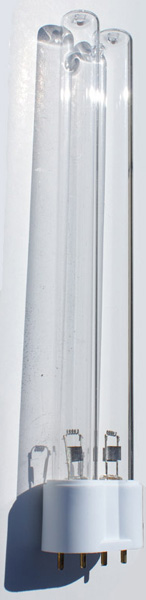
Compact UV Bulb, uv replacement bulbs, 5, 7, 9, 13, 18, 36 watt Compact UV Replacement bulbs For (PLS, PLL, with G11 & G23 bases to fit 95% of UV Clarifiers/Sterilizers calling for this type of UVC bulb, please click the picture on the left.

Monday, January 21, 2008

Fish Immune and UV Sterilizers

Fish Immune System and UV Sterilization

UV Sterilizers, Terminator, Custom, Gamma

I have seen many comments posted in various places on the internet claiming that running a UV Sterilizer 24/7 will weaken the immune system in fish in part by creating a sterile environment.
I have tried to find more information as to how this myth got its start and the best I can come up with is that many are equating UVC radiation (emitted in UV Sterilizers) to Ozone produced by Ozone Generators

Aquarium Ozone GeneratorFirst even though I have not found an Ozone Generator as effective a most UV Sterilizers, even here properly used the Ozone is not added to the aquarium.
However more importantly is that a UV Sterilizer keeps ALL UVC radiation inside the unit and this reaction actually breaks apart free radicals and other oxidizers such as Ozone (similar to the reaction of Ozone and UV light energy in the upper atmosphere of Earth).

What is most important to note is that a properly installed UV Sterilizer will IMPROVE a fish’ immune system by creating a better Reducing Redox environment in the aquarium after water has passed through the sterilizer (providing it is a reasonably good unit such as the Custom I use or the Terminator amongst many other good units as well).
Here is a quote from "Aquarium Redox Potential":
"A proper Redox Potential improves the health of humans AND fish. A Redox Potential in the -200-400 mV range in human studies has been shown to have the same affect as anti-oxidant preparations such Vitamin C (and many others). In medical studies the enhanced oxidizing environment can facilitate the binding of pathogens or antigens to effector cells (a type of lymphocyte that are actively engaged in secreting antibodies) leading to a hyper-responsive innate immune system. Previous work has shown that an oxidizing environment leads to enhanced release of super-oxide and nitric oxide, activation and translocation of nuclear transcription factor and enhanced production of cytokines (proteins and peptides that are signaling compounds produced by animal cells to communicate with one another). The creation of a markedly reduced environment by addition of antioxidants blunts all of the above primary responses of the innate immune system."

In studies using human blood therapy, the use of UVC to irradiate blood, these are just a few of the findings:
*Improved circulation and oxygenation of tissues
*Anti-inflammatory effects
*Stimulation of the Immune System
*Increased Tolerance of the body to Chemotherapy and Radiation
*Cardiovascular protection
*Powerful Anit-Infection Properties
See this article for more: Oxygen Healing Therapies with UVC

It should also be noted that a UV Sterilizer cannot create a sterile environment as it cannot reach all aspects of the aquarium such as gravel, filter media, and the fish internally!

It is unfortunate that these false statements are still widely circulated, I recommend reading this article about UV Sterilization for more:
Ultraviolet Sterilization in Aquariums and Ponds

Or this article about Aquarium Redox:
Aquarium Redox Potential

Or even this article about Aquarium Calcium, GH, KH, pH (as this is also an important aspect as well to a healthy fish immune system):
CALCIUM, ELECTROLYTES, AND MAGNESIUM IN AQUARIUMS;

Monday, December 24, 2007

UV lamps

UV (UVC) lamps (bubs) used in Aquariums and Ponds and how they work.

This post is primarily dealing with UV bulbs (or lamps which is a more correct term) emitting UVC radiation used in the Aquarium/Pond Industry, although I will discuss other UV bulb types as well since these may someday show up in the Aquatics Industry which tends to lag behind the mainstream technical, filtration, and other innovations in many ways such as in Aquarium Lighting (the SHO and T2 lights are good examples of where the Aquarium Industry has yet to embrace these high performers in overhead aquarium lights).

There are two common UVC emitting lamps types currently employed: the low pressure and the medium pressure mercury lamp.

The low pressure lamp emits its radiant energy between 250-260 NM which is where UV Sterilization is most effective with a UVC efficiency of about 38%.

The medium pressure lamp emits its radiant energy between 250 and 350 with many energy spikes in between (most notably around 320 which is more in the UVB range) with a UVC efficiency around 7%.

Please click diagram to enlarge
low and medium pressure, uv bulb, lamp comparison
The low pressure lamp is clearly the better choice based on this information, however the low pressure lamp does have one flaw which the medium pressure lamp does not suffer from and that is the low pressure lamp is affected by water (or air) temperatures and operates best between 20 C (68 F) and 40 C (104 F). Generally this is not a major concern considering most aquarists operate their aquariums in well within this range. With ponds, this is still not a major concern in that most problems, including algae occur in warmer months. This problem can be also addressed with in-line heaters to pre-warm the water. Many UV Sterilizers come with quartz sleeves which form an air pocket between the lamps and water that in theory increases operating temperatures; HOWEVER my own tests have shown this improvement to be nominal at best especially when compared to a well designed direct contact UV Sterilizer. In a test with a custom 15 Watt UV Sterilizer and a 13 Watt Quartz sleeve UV Sterilizer (a well designed one at that), the increase in temperate was only 2 degrees F (I have observed up to 5 degrees depending on the units compared). This test started at 68 F and was conducted over 15 minutes, then water was removed from the units and the temperature measured. Unfortunately the quartz sleeve is accepted as a standard that sounds great in theory, but in practicality is not a true improvement in most applications (I would recommend them in some applications such as Lobster tanks, but even here a pre-heater would also be recommended).

Please see this article for much more about UV Sterilization: ULTRAVIOLET STERILIZATION (How UV sterilization works) . This article explains the benefits and myths about aquarium and pond uv sterilization


High Output Amalgam UV Sterilizer Now a potential improvement is the Amalgam High Output low pressure lamp. These lamps operate in a wider temperature range than standard low pressure lamps. These lamps are not without their problems too; even though not affected by water temperature fluctuations, these lamps can take 800 seconds to get to full power, and the warm up time is temperature dependant. The lamp life is often below the expected hours due to failure caused by the filaments becoming brittle and deposits of mercury oxide causing the ends to become black. This leads to poor heat dissipation and is the most probable failure mode. These lamps and the UV Sterilizers that contain them are also very expensive as well.

Another aspect of UV lamps that should be noted is how they function or start. Most UV lamps commonly used are Hot Cathode UV lamps. The Hot Cathode Germicidal UV Lamps are similar in their operation to the standard fluorescent lamps. The Hot Cathode lamp operates from a ballast or transformer and requires a device such as the glow switch starter to preheat the electrodes in order to start the lamp. The electrodes, located at the ends of the lamp, are tungsten filaments coated with emission material and, under normal operation, govern the life of the lamp. In view of the fact that the life of the electrodes is shortened by frequent starts, the lamp life is rated according to the number of times the lamp is started. Operation at low temperatures may result in excessive lamp blackening and rapid depreciation in ultraviolet output.

References:
http://americanaquariumproducts.com/AquariumUVSterilization.html
http://www.americanairandwater.com/lamps.htm